← Back to Hub Next: Module 02 →
Week 1 | Part I

The Utopian Dawn

The Construction of the Liberal Digital Order 1990-2000

How three intellectual currents fused into a decade of techno-liberal optimism, shaping the architecture of the internet and the geopolitical assumptions that would define the digital age.

Begin Reading
Foundations

The Intellectual Climate

The 1990s were shaped by a convergence of three powerful intellectual currents. Each emerged from different disciplines—political philosophy, economics, and technology policy—but together they formed an ideological foundation for what would become the liberal digital order.

1
1992

The End of History

Francis Fukuyama declared liberal democracy as the "final form of human government," suggesting the ideological battles of the 20th century had been won.

"What we may be witnessing is not just the end of the Cold War, but the end of history as such."

— Francis Fukuyama

2
1945 / 1990s

Knowledge & Computing

Hayek's 1945 essay on distributed knowledge was reinterpreted: the personal computer became an anti-Soviet tool for decentralizing information.

"The Use of Knowledge in Society" — the price system as a mechanism for communicating information.

— F.A. Hayek

3
1990

Ideas as Non-Rival Goods

Paul Romer's endogenous growth theory: ideas are non-rival goods that can be shared without being depleted, creating infinite growth potential.

"Endogenous Technological Change" — the economics of infinite replication and network effects.

— Paul Romer

Key Insight

The Fusion of Optimism

These three convictions fused into a powerful narrative: technology + markets + openness = inevitable progress. The internet was not merely a communication tool—it was the material embodiment of liberal democratic values, destined to spread freedom and prosperity globally. This ideological framework would shape every major policy decision of the decade.

Chronology

A Decade of Digital Transformation

The pivotal moments that constructed the liberal digital order, from the fall of the Berlin Wall to the dot-com bubble's peak.

1990

Endogenous Technological Change

Paul Romer publishes his seminal paper establishing the economic theory that would justify the information economy. Ideas, unlike physical goods, can be shared without being depleted—creating the theoretical foundation for infinite growth through knowledge sharing.

August 1991

World Wide Web Goes Public

Tim Berners-Lee releases the first web browser and server software on the internet. The web's open architecture—built on HTTP, HTML, and URL standards—embodies the decentralized, non-proprietary ethos that would define the era.

1992

The End of History

Francis Fukuyama's book declares liberal democracy victorious. The ideological battles of the 20th century are over; free markets and democratic governance represent humanity's endpoint. Technology becomes a vehicle for this inevitable historical trajectory.

April 1993

The Clipper Chip Proposal

The Clinton administration proposes the Clipper Chip—a hardware encryption standard with government backdoor access. The proposal reveals the first major tension: openness versus surveillance in the digital realm.

March 21, 1994

Al Gore's Buenos Aires Speech

Vice President Gore announces the Global Information Infrastructure (GII) initiative, outlining five principles that would guide U.S. digital policy: private sector leadership, competition, open access, universal service, and flexible regulation.

May 1994

Matt Blaze's Discovery

AT&T researcher Matt Blaze discovers a critical vulnerability in the Clipper Chip's escrow system. The technical failure accelerates the shift from hardware-based surveillance to market-based dominance strategies.

February 8, 1996

Barlow's Declaration

John Perry Barlow publishes "A Declaration of the Independence of Cyberspace" in Davos, proclaiming: "Governments of the Industrial World, you weary giants of flesh and steel, I come from Cyberspace, the new home of Mind."

February 1996

Telecommunications Act

The most significant overhaul of U.S. communications law in 62 years. Title I vs Title II classification debates begin. Section 230 is inserted—"the 26 words that created the Internet"— providing liability protection for online platforms.

February 1997

WTO Basic Telecom Agreement

69 countries commit to opening their telecommunications markets to foreign competition. The agreement institutionalizes the liberal approach to digital infrastructure globally, embedding market principles in international trade law.

1998

ICANN Formation

The Internet Corporation for Assigned Names and Numbers is created to manage domain names and IP addresses. The U.S. government retains ultimate authority, establishing a model of private governance with public oversight.

March 2000

Clinton's Trojan Horse

President Clinton admits the difficulty of regulating the internet: "It's like trying to nail Jell-O to the wall." The comment reveals both the hubris of the hegemon and a fundamental category error—treating the internet as merely "information" rather than infrastructure.
Policy Architecture

The Grand Strategy: Global Information Infrastructure

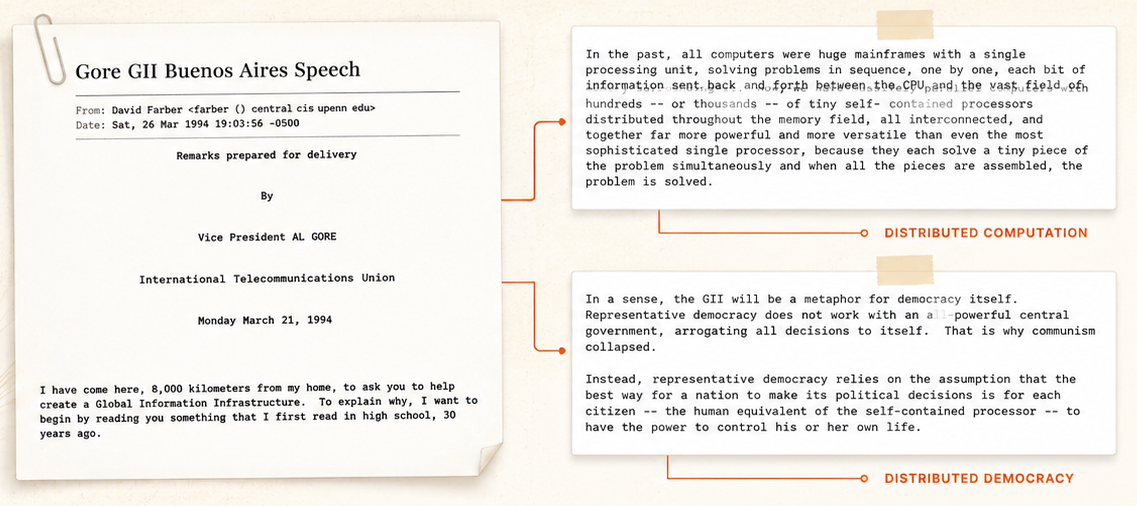
On March 21, 1994, Vice President Al Gore delivered a speech in Buenos Aires that would define American digital policy for a generation. The Global Information Infrastructure (GII) initiative was more than a technical proposal—it was a geopolitical strategy dressed in technological clothing.

The GII will not only be a metaphor for a functioning democracy, it will in fact promote the functioning of democracy by greatly enhancing the participation of citizens in decision-making.

Al Gore

Vice President, United States

Buenos Aires, March 21, 1994
Strategic Intent

Liberal Hegemony via Connectivity

The GII was designed as a trojan horse for American values. By building the infrastructure of global communication, the U.S. would embed its principles—free speech, market competition, open access—into the very architecture of the digital world. Connectivity became a form of soft power, spreading liberal democratic norms through technical standards rather than political coercion.

The Five Principles of GII

Private Sector Leadership

Government facilitates; industry builds and operates.

Competition

Multiple providers ensure innovation and lower costs.

Open Access

Networks must interconnect; no walled gardens.

Universal Service

Affordable access for all, bridging the digital divide.

Flexible Regulation

Light-touch approach that adapts to rapid change.

The Internal Contradiction

The Clipper Chip Wars

The first major battle over encryption revealed a fundamental tension in the liberal digital order: openness versus surveillance, freedom versus security.

The Proposal

April 1993

The Clinton administration proposed the Clipper Chip—a hardware encryption standard for voice and data communications that included a "key escrow" system. The government would hold copies of encryption keys, allowing law enforcement to decrypt communications with a warrant.

The goal: enable strong encryption for commercial use while preserving law enforcement's ability to intercept communications.

The Backlash

1993-1996

Civil liberties groups, technology companies, and cryptographers united in opposition. The core argument: any backdoor accessible to "good guys" would eventually be found by "bad guys." Trust in government key escrow was impossible in a networked world.

The Electronic Frontier Foundation and industry leaders argued that mandating weakened encryption would harm U.S. competitiveness and civil liberties.

May 1994

Matt Blaze's Discovery

AT&T Bell Labs researcher Matt Blaze published a paper demonstrating a critical vulnerability in the Clipper Chip's escrow system. He showed that the protocol's authentication mechanism could be subverted, potentially allowing users to bypass the government backdoor entirely.

The technical failure became political: Blaze's discovery proved that the Clipper Chip couldn't deliver on its promises. The hardware-based surveillance model was fundamentally flawed.

Strategic Pivot

From Hardware to Market Dominance

The Clipper Chip's failure forced a strategic shift. Rather than mandating surveillance through technical standards, the U.S. pivoted to market dominance. If American companies controlled the platforms, servers, and infrastructure of the global internet, surveillance could happen through corporate cooperation rather than technical mandate. The NSA's budget shifted from trying to weaken encryption standards to breaking into systems directly—culminating in programs like PRISM revealed by Edward Snowden in 2013.

Legislative Milestones

The Telecom Act of 1996

Signed into law on February 8, 1996, the Telecommunications Act was the most significant overhaul of American communications law in 62 years. It rewrote the rules for the internet age—and embedded decisions that would shape digital governance for decades.

The Classification Debate: Title I vs Title II

Title I Information Service
  • Light-touch regulation
  • No common carrier obligations
  • Freedom to prioritize traffic
  • Minimal FCC oversight
Title II Telecommunications Service
  • Common carrier regulation
  • Non-discrimination requirements
  • Net neutrality obligations
  • Universal service contributions

Section

230

"The 26 Words That Created the Internet"

"No provider or user of an interactive computer service shall be treated as the publisher or speaker of any information provided by another information content provider."

These 26 words established liability protection for online platforms, enabling the user-generated content model that would power social media, search engines, and the entire Web 2.0 ecosystem. Platforms could moderate content without becoming legally responsible for everything users posted.

WTO Basic Telecommunications Agreement

February 1997

One year after the Telecom Act, the World Trade Organization cemented the liberal approach to digital infrastructure globally. 69 countries representing over 90% of global telecommunications revenues committed to opening their markets to foreign competition.

69

Countries

90%+

Global Telecom Revenue

$1T

Market Value

February 8, 1996 — Davos, Switzerland
Declaration

The Declaration of the Independence of Cyberspace

"Governments of the Industrial World, you weary giants of flesh and steel, I come from Cyberspace, the new home of Mind. On behalf of the future, I ask you of the past to leave us alone. You are not welcome among us. You have no sovereignty where we gather."

John Perry Barlow

Co-founder, Electronic Frontier Foundation

The Manifesto

Barlow's "Declaration of the Independence of Cyberspace" was written in response to the Telecommunications Act. It articulated a vision of the internet as a separate realm—immaterial, borderless, and beyond the reach of traditional governments. The language echoed the American Declaration of Independence, positioning cyberspace as a new frontier for human liberation.

The Myth of Immateriality

Barlow's declaration rested on a fundamental misconception: that cyberspace was somehow separate from physical reality. In fact, the internet depends entirely on material infrastructure—servers, cables, data centers, and the electricity that powers them. All of this exists within territorial jurisdictions, subject to national laws and sovereign control.

The Ideological Function

Barlow's declaration served a crucial ideological purpose: it naturalized American dominance of the internet as "freedom" rather than hegemony. By framing cyberspace as a realm beyond government, it obscured the very real power structures—corporate control, infrastructure ownership, and technical standards—that concentrated influence in American hands. The myth of immateriality became a shield for material interests.

The Hubris of the Hegemon

Clinton's Trojan Horse Thesis

"It's like trying to nail Jell-O to the wall."

— President Bill Clinton, March 2000

On the difficulty of regulating the internet

The Hubris

Clinton's comment reflected a particular kind of American confidence—the belief that the internet was inherently ungovernable, that its distributed architecture made traditional regulation impossible.

This hubris served American interests: if the internet couldn't be regulated, then U.S. companies could operate globally without interference from foreign governments. The "ungovernability" of cyberspace became a justification for laissez-faire policies that benefited Silicon Valley.

The Category Error

Clinton's statement reveals a fundamental misunderstanding: treating the internet as merely "information" rather than infrastructure.

Information may be hard to regulate, but infrastructure is not. The cables, servers, data centers, and corporate entities that constitute the internet are all eminently regulable. China would prove this within years, demonstrating that sovereign control over digital infrastructure was not only possible but effective.

Critical Reflection

The Blind Spot of Liberal Hegemony

The 1990s consensus assumed that American values would spread naturally through technology, that connectivity would inevitably produce liberalization. This assumption blinded policymakers to alternative possibilities: that the same infrastructure could be used for surveillance, that platforms could become instruments of control, that authoritarian states could adapt the internet to their own purposes. The Trojan Horse thesis assumed the horse would only work in one direction—outward. It didn't account for what might climb back in.

Looking Ahead

By 2000, the architecture of the liberal digital order was in place: open markets, light-touch regulation, corporate leadership, and the assumption that technology would spread democratic values. But the contradictions were already visible—the surveillance debates, the platform power concentrations, the gap between rhetoric and reality.

The next decade would test these foundations. The dot-com crash, 9/11, the rise of social media, and the emergence of alternative models—particularly from China—would challenge the assumptions that had seemed so certain in the 1990s. The liberal digital order was about to face its first serious crises.

Summary

Key Insights from Part I

Convergence

Three intellectual currents—Fukuyama's end of history, Hayek's distributed knowledge, and Romer's endogenous growth—fused into a powerful narrative that shaped 1990s digital policy.

Hegemony

The GII was designed as a vehicle for American values, embedding liberal democratic principles into the technical architecture of the global internet.

Contradiction

The Clipper Chip wars revealed the tension between openness and surveillance, forcing a strategic shift from hardware mandates to market-based dominance.

Legislation

The Telecom Act of 1996 and Section 230 established the legal framework for the platform economy, with consequences still debated today.

Mythology

Barlow's declaration articulated the myth of cyberspace as immaterial and borderless, obscuring the material infrastructure and power structures that enabled American dominance.

Blind Spot

Clinton's "Jell-O" comment revealed a category error—treating the internet as mere information rather than regulable infrastructure—and a dangerous hubris about American technological supremacy.

Sources & References

[1]

Fukuyama, Francis. The End of History and the Last Man. Free Press, 1992.

[2]

Hayek, F.A. "The Use of Knowledge in Society." American Economic Review, Vol. 35, No. 4, 1945, pp. 519-530.

[3]

Romer, Paul M. "Endogenous Technological Change." Journal of Political Economy, Vol. 98, No. 5, 1990, pp. S71-S102.

[4]

Gore, Al. "Remarks at the International Telecommunications Union." Buenos Aires, Argentina, March 21, 1994.

[5]

Blaze, Matt. "Protocol Failure in the Escrowed Encryption Standard." Proceedings of the 2nd ACM Conference on Computer and Communications Security, 1994.

[6]

Telecommunications Act of 1996. Pub. L. No. 104-104, 110 Stat. 56 (1996).

[7]

47 U.S.C. § 230 — Protection for private blocking and screening of offensive material.

[8]

WTO Agreement on Basic Telecommunications. Geneva, February 15, 1997.

[9]

Barlow, John Perry. "A Declaration of the Independence of Cyberspace." Electronic Frontier Foundation, February 8, 1996.

[10]

Clinton, William J. Remarks on Internet Policy. March 2000.